
It was 1992. A young undergraduate philosophy student, Shyam Ranganathan, sat hunched over a text by Plato, a strange sense of distance growing in his mind. His professor had been clear: base your writing on the classics, stay close to the text. But how could he? The words on the page were English, but Plato wrote in Greek. The student wasn’t reading Plato; he was reading a translator’s best guess. A question sparked in his mind, a question that would ignite a decades-long journey: How does anyone truly succeed in translation, so that what we read is the same thing the author wrote? \[Ref 1\]
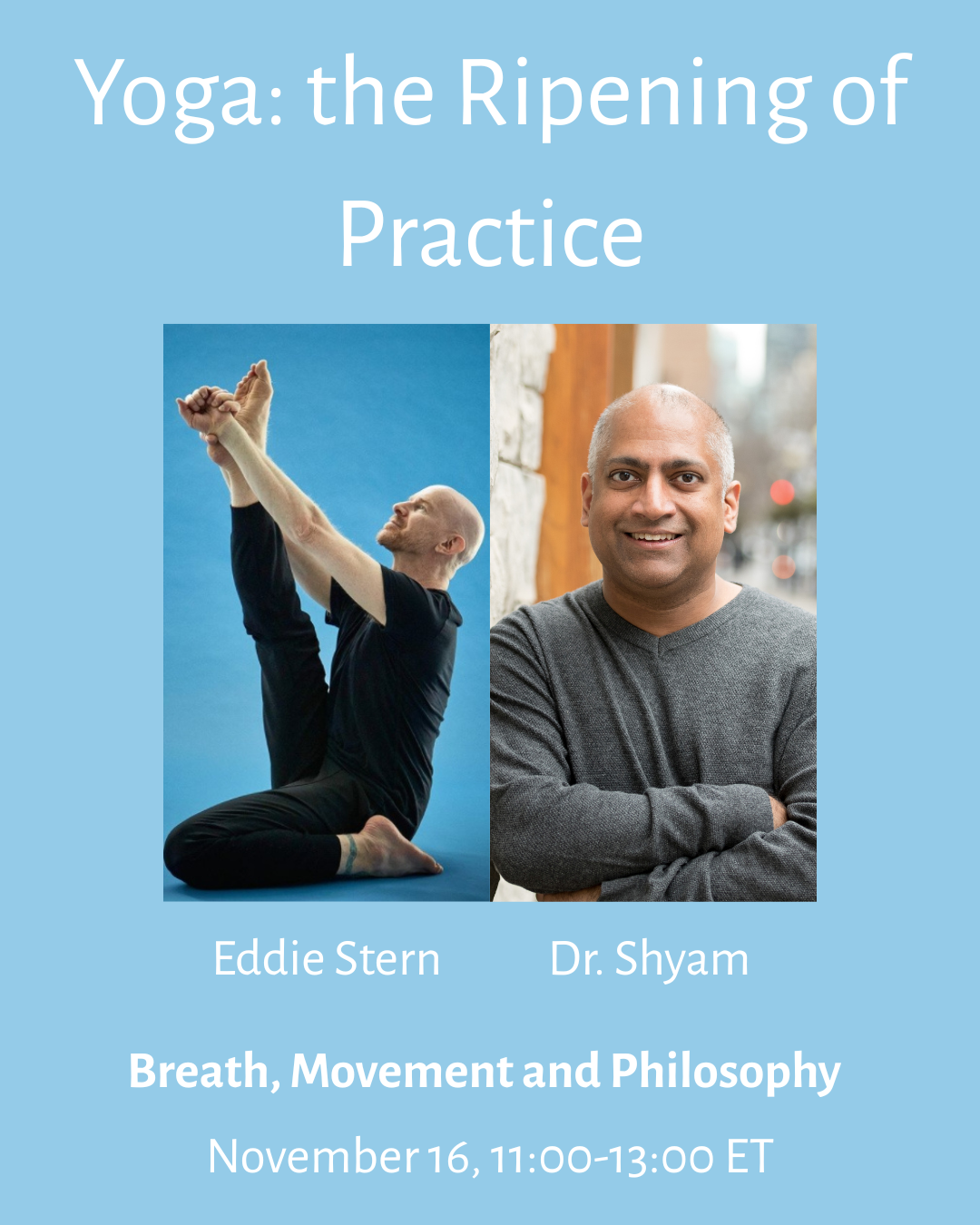
That young student was the future Dr. Shyam Ranganathan, and that single question would lead him to unravel colonial myths, challenge academic dogma, and ultimately rediscover the profound, practical core of yoga philosophy. Unlike many scholars, Dr. Shyam is not just an academic observer; he’s a lifelong yoga practitioner, having inherited the practice from his family and ancestors. This unique position—as both a rigorously trained philosopher and an initiated yogi—has allowed him to bridge a gap that has confused seekers for centuries \[Ref 1\].
The Making of a Field-Changing Scholar
Dr. Shyam’s academic path was a relentless pursuit of clarity. After deeply studying the Western tradition through a BA and MA in Philosophy, he turned his focus to his own heritage with an MA in South Asian Studies. It was there he encountered a startling and pervasive myth: that South Asian philosophers had little to say about ethics and were purely religious. He immediately recognized this as a story you tell about a culture you want to colonize \[Ref 1\].
Driven to correct this narrative, he dove into the primary texts, learning the original languages to get closer to the source. This research culminated in his first book, Ethics and the History of Indian Philosophy. In it, he made a groundbreaking argument: South Asian philosophers were, in fact, obsessed with ethics, and their word for it was “dharma.” It was the first book on Indian Ethics in decades and established him as a leading voice on classical Indian moral philosophy \[Ref 1\].
But Dr. Shyam wasn’t satisfied. He knew his argument relied on assumptions about language and translation that needed deeper investigation. This led to his PhD dissertation, which showed how translation works in general, and specifically for philosophy. Armed with this advanced research, he tackled one of the most revered and misunderstood yoga philosophy books of all time: the Yoga Sūtra of Patañjali \[Ref 1\].
For those asking, “What are the yoga sutras?”—they are the foundational text of classical yoga philosophy, but many scholars confess to not understanding them. Dr. Shyam realized this confusion stemmed from a profound ignorance of what philosophy actually is. His translation, in stark contrast, was produced using the same rigorous principles that could be used for any philosophical text, finally offering an accessible explanation of the Patañjali yoga sutras’ meaning \[Ref 1\].
Through this work, he formulated a crucial distinction:
- Interpretation: Explaining something by projecting your own beliefs onto it. This, he realized, is a tool of oppression and confusion.
- Explication: Explaining something in terms of its own internal logic, reasons, and arguments. This is the path to true understanding and freedom.
He was stunned to find that this very distinction lies at the foundation of the Yoga tradition itself (YS I.2-4). His later work, including the 2024 book Yoga Anticolonial Philosophy, continued this thread, showing how Yoga is a powerful anti-oppressive ethical theory. Written for students and practitioners, this work serves as an excellent guide to yoga philosophy for beginners, showing how modern practice can be a way to live ancient, anti-oppressive wisdom, moving beyond a simple list of the eight limbs of yoga explained to reveal their radical, freedom-oriented core \[Ref 1\].
A Mission Born from a Simple Suggestion
For years, Dr. Shyam poured his field-changing research into scholarly volumes and university classrooms. But it was his wife who sparked the next chapter. She had been the one, back when he was a graduate student, who first encouraged him to teach the Yoga Sūtra. Now, she had another idea: share this incredible knowledge online \[Ref 1\].
In 2019, he founded Yoga Philosophy (yogaphilosophy.com), which has since grown into the Yoga Philosophy Institute. He quickly discovered something profound. When philosophy was taught not as an abstract theory but as a practical discipline—a practice—it became a catalyst for real transformation. Students weren’t just learning ideas; they were changing how they saw the world and their place in it. They were becoming clearer, freer, and more intentional in their lives \[Ref 1\].
This validated a core insight: at its best, philosophy is a form of coaching. It’s a method for strengthening the mind and spirit. This realization led to the creation of ΦPhilosophit™, a project dedicated to bringing the transformative power of philosophical practice to anyone ready to reshape their reality \[Ref 1\].
A Unique Home for Authentic Yoga Philosophy
The Yoga Philosophy Institute stands apart. It is not just another platform discussing yoga. It is an online initiative dedicated to a philosophy-based education in yoga, grounded in the principles of explication—of reason, logic, and argument—over interpretation \[Ref 1\].
Led by Dr. Shyam—a scholar uniquely trained in both philosophy and the yoga tradition—the Institute offers a path away from the confusion and colonial baggage that has distorted our understanding of yoga. It’s a space where students can bypass the projections of gurus and academics alike and engage directly with the brilliant, life-affirming logic at the heart of the practice. It is a return to the source, guided by someone who has dedicated his life to clearing the path \[Ref 1\].
Start Your Journey with a Free Course
The deepest insights of yoga are not locked away in dusty, incomprehensible texts. They are practical tools for living a life of freedom, clarity, and purpose. Dr. Shyam has dedicated his career to making these tools accessible, and he invites you to begin your own journey of discovery.
His landmark book, Yoga Anticolonial Philosophy, comes with a free companion course hosted by the Yoga Philosophy Institute. This is your chance to learn directly from a master scholar and practitioner and to see for yourself how this ancient wisdom can transform your modern life. Don’t just practice yoga—understand it.
Click here to explore the free course and start your journey into authentic yoga philosophy today.